


Walk through any modern city and you’ll see them everywhere, like on curved stone doorways, bridge spans, and tunnel openings. These aren’t just pretty details. They’re direct descendants of Roman engineering geniuses from over 2,000 years ago.
The Romans didn’t invent the arch, but they perfected it. They turned a simple curved structure into the backbone of an empire. Roads, bridges, aqueducts, and massive buildings all relied on this one brilliant design.
This article breaks down exactly how Roman arches work and why they matter today. You’ll learn the engineering principles that made Rome’s structures last millennia. We’ll explore real examples you can visit right now.
As someone who has studied ancient construction techniques for years, I’ll show you the facts without the fluff.
Ready to see how Romans changed construction forever? Let’s start with the basics.
The Origins of the Roman Arch
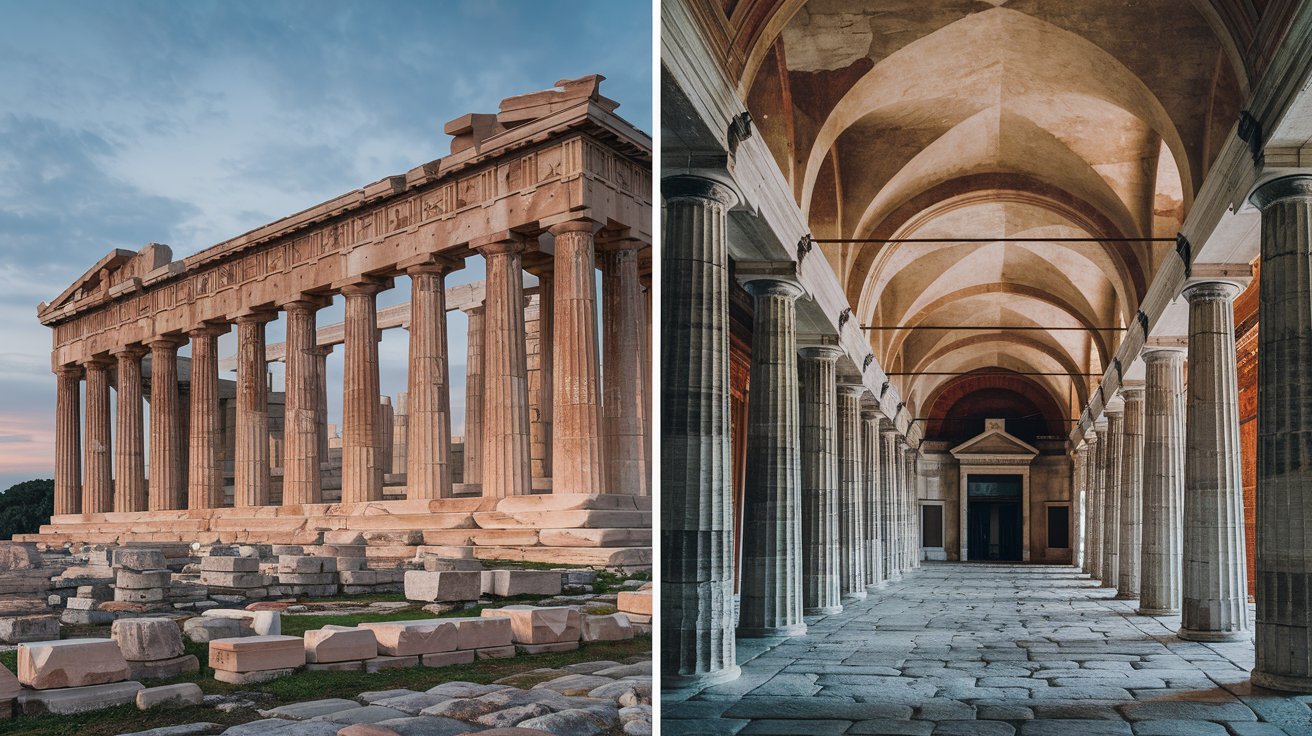
The Romans revolutionized architecture by improving the Greek style with arches, enabling wider, stronger, and more durable structures without relying on columns.
Greek Influence and Roman Innovation
The Greeks gave the world some incredible buildings. Think of the Parthenon with its massive columns holding up heavy stone beams.
Greek architects loved three main styles: Doric, Ionic, and Corinthian. Each had different column tops and decorative features.
But here’s the thing: Greek buildings had a big limitation. They used a post-and-lintel system. Imagine two fence posts with a board laid across the top. That’s basically how Greek temples worked, just with stone columns and heavy stone beams.
This system looked great but had problems. Stone beams can only span so far before they crack under their own weight. Want a bigger interior space? You need more columns. The Greeks ended up with forests of columns inside their buildings.
Romans admired Greek style but wanted something different. They needed to build bigger spaces for their growing empire. Massive bath houses, law courts, and market halls required wide-open interiors without columns blocking the view.
The Birth of the Arch
The Romans found their answer in an old Middle Eastern invention – the arch. But they didn’t just copy it. They made it better and used it everywhere.
Here’s how a Roman arch works. Instead of laying one heavy stone beam across two supports, the Romans used wedge-shaped stones called voussoirs. These stones lean against each other, creating a curved span. The top stone, the keystone locks everything in place.
During construction, workers built wooden frames to hold the stones until they placed the keystone. Once complete, they removed the wood. The arch now supported itself through compression. Each stone pushed against its neighbors, creating a structure stronger than any single beam.
This was revolutionary. Roman arches could span much wider gaps than Greek lintels. They distributed the weight more evenly. And they lasted much longer – many Roman arches still stand today, while Greek lintels often cracked centuries ago.
The Romans had found their signature move. Soon, arches would transform how humans built everything.
Architectural Evolution from Arches
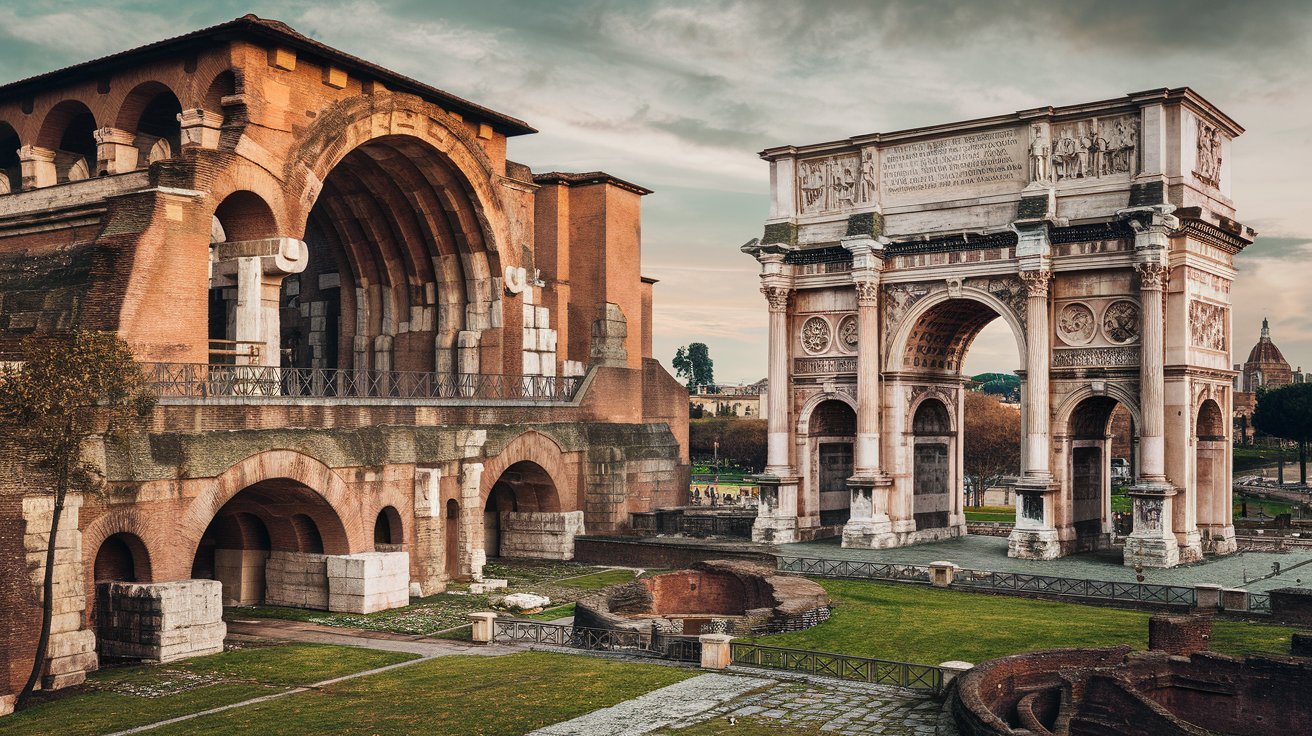
Romans expanded on the arch to build barrel and groin vaults, enabling vast open spaces, while triumphal arches symbolized both architectural genius and imperial power.
The Barrel Vault and Tunnel Construction
Romans took their arch idea further. They extended arches along their length to create barrel vaults – basically stone tunnels with curved ceilings.
This changed everything. Instead of multiple arches, one barrel vault covered long, wide spaces. The Baths of Caracalla used these for huge swimming areas. The Colosseum’s underground corridors relied on barrel vaults, too.
One problem: barrel vaults pushed outward along their entire length. This required thick, heavy walls.
The Groin Vault Breakthrough
Roman engineers found a better way. They crossed two barrel vaults at right angles over square spaces. This created groin vaults – named for the ridge lines that looked like human anatomy.
Groin vaults were brilliant. Instead of pushing on entire walls, they focused all weight onto four corner points. Walls could be thinner or even removed between corners.
This enabled massive open interiors. The Baths of Diocletian had huge floors with 100-foot stone ceilings overhead. Engineers could also add clerestory windows – high windows that brought light without weakening walls.
Medieval cathedral builders copied this Roman technique. Gothic cathedrals still use groin vault principles today. Romans had turned simple arches into the foundation for history’s most impressive interior spaces.
Functional and Symbolic Beauty
Romans loved to celebrate military wins. When generals returned from successful campaigns, the city threw massive parades called Triumphs. Victorious armies marched through Rome’s streets, showing off captured treasures and prisoners.
But parades end. Romans wanted something permanent to remember these victories. So they built triumphal arches – massive stone gateways that soldiers could march through during their victory celebrations.
These weren’t just doorways. They were giant advertisements carved in stone. Relief sculptures showed battle scenes, captured enemies, and Roman gods blessing the victory. Bronze letters spelled out the general’s accomplishments for everyone to read.
The arches served a clever dual purpose. They celebrated past victories while reminding citizens of Roman military power. Walking under these monuments, people couldn’t forget who ruled the world.
Examples of Roman Triumph Arches
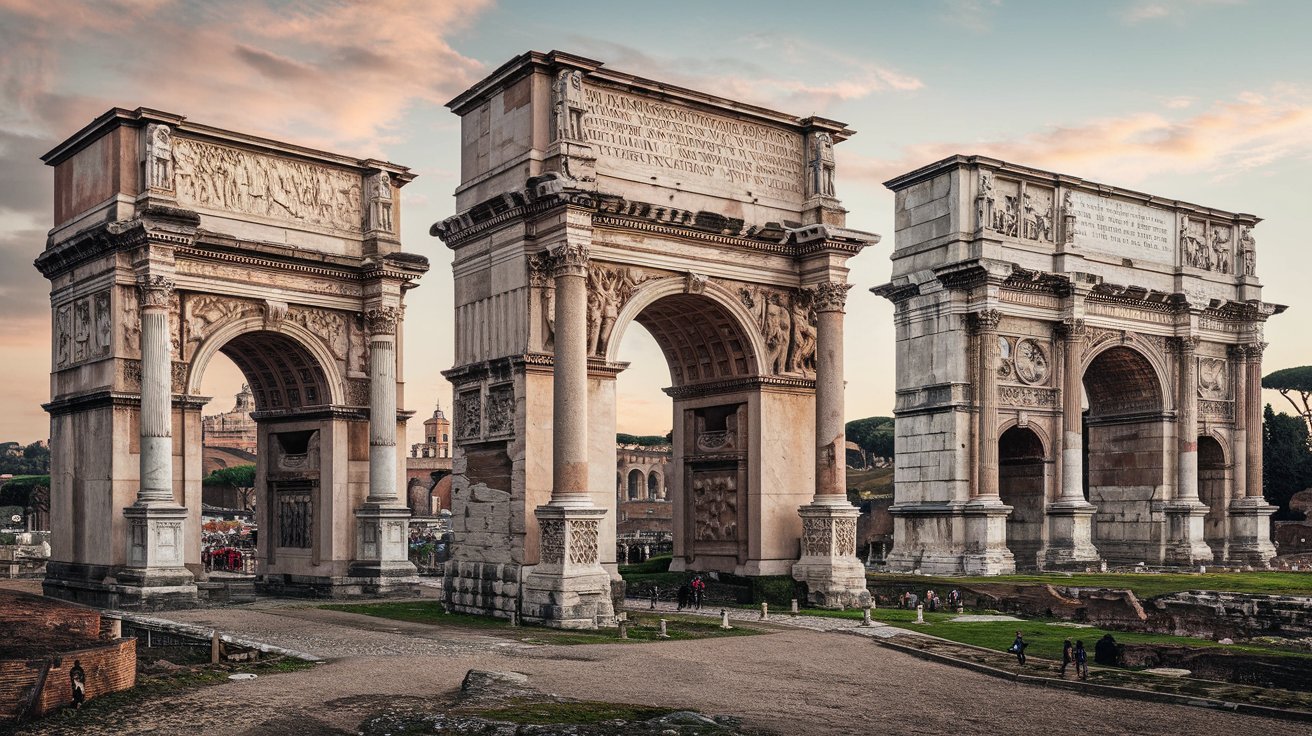
Arch of Titus
Built around 82 CE, this arch honors Emperor Titus’s victory over Jewish rebels in Jerusalem. The reliefs inside show Roman soldiers carrying treasures from the destroyed Jewish Temple, including the famous golden menorah.
Titus’s arch still stands in the Roman Forum. For centuries, Jewish people refused to walk under it because of what it represented. Today, it remains one of Rome’s most visited monuments.
Arch of Septimius Severus
Emperor Septimius Severus built this triple arch in 203 CE to celebrate victories in modern-day Iraq. Three archways allowed more traffic flow during ceremonies. Detailed carvings show Roman armies conquering Parthian cities.
The arch’s bronze letters originally listed all of Severus’s military achievements. Though the bronze is gone, you can still see where the letters attached to the stone.
Arch of Constantine
This is Rome’s largest surviving triumphal arch, built in 315 CE. Constantine erected it after defeating his rival Maxentius at the Battle of Milvian Bridge. Interestingly, much of its decoration was recycled from earlier monuments.
Constantine’s arch marks a turning point in Roman history. He was the first Christian emperor, and this victory helped establish Christianity throughout the empire. The arch still dominates the area between the Colosseum and Roman Forum.
These monuments show how Romans used their engineering skills for more than just practical buildings. They created lasting symbols of power that still impress visitors 2,000 years later.
Legacy of the Roman Arch

Roman arches shaped global architecture and culture, inspiring structures from Gothic cathedrals to modern monuments, while symbolizing strength, transition, and enduring legacy.
Influence on Global Architecture
Roman arches didn’t disappear when the empire fell. Medieval builders studied Roman ruins and copied their techniques. Gothic cathedral architects took Roman arch principles and pushed them even further.
Look at Notre Dame or Chartres Cathedral. Those soaring stone ceilings use the same groin vault system the Romans perfected. The pointed Gothic arches work on identical engineering principles – stones in compression, weight transferred to specific points.
But Romans influenced more than just churches. Modern nations built their own triumphal arches to copy Roman grandeur. Napoleon commissioned the Arc de Triomphe in Paris after studying Roman examples. The Brandenburg Gate in Berlin borrows Roman proportions and symbolism.
London’s Wellington Arch celebrates victory over Napoleon – ironically using Roman design ideas. Washington DC’s Union Station shows Roman arches adapted for train travel. Even the Gateway Arch in St. Louis follows Roman structural principles, just stretched into a massive steel curve.
Architects today still turn to Roman examples. Modern shopping malls, airports, and sports stadiums use arch-based designs for wide, open spaces. The engineering math hasn’t changed much in 2,000 years.
Roman Arches as Cultural Symbols
Beyond their engineering value, Roman arches became powerful symbols. An arch creates a threshold – you pass from one space to another. This made arches perfect metaphors for important transitions in life.
Wedding ceremonies often happen under arches. Graduation processions pass through archways. These rituals echo ancient Roman ideas about crossing from one state of being to another.
Arches also represent strength and permanence. When cities want to honor important people or events, they still build arches. The Vietnam Veterans Memorial in Washington includes arch elements. Mumbai’s Gateway of India copies Roman triumphal arch design.
Key Tips from Roman Arch Engineering
- Start with solid foundations: Roman arches only work when built on stable ground that can handle concentrated weight loads
- Use the keystone principle: In any project, identify the critical element that holds everything else together
- Distribute pressure wisely: Instead of putting all stress on one point, spread forces across multiple support areas
- Build temporary supports: Use scaffolding or frameworks during construction, then remove them once the structure is self-supporting
- Think in three dimensions: Extend successful two-dimensional solutions into full spatial applications
Conclusion
The Roman arch stands as one of history’s greatest engineering achievements. From simple curved stones, the Romans created a system that could span vast distances, support enormous weights, and last for millennia. Their innovation transformed architecture forever.
Today, we still see Roman influence everywhere. Gothic cathedrals, modern monuments, and contemporary buildings all rely on principles Romans perfected 2,000 years ago. The Arc de Triomphe, Brandenburg Gate, and countless other structures pay tribute to Roman ingenuity.
Beyond engineering, Roman arches became powerful symbols of strength, transition, and permanence. They represent humanity’s ability to overcome obstacles and connect divided spaces.
The next time you walk under an archway, remember you’re experiencing Roman genius. Their curved stones continue to shape how we build, live, and think about space itself.
Frequently Asked Questions
How did Roman arches stay up without modern cement?
Romans used precisely cut stones that fit together perfectly through compression. Each wedge-shaped stone pushed against its neighbors, creating a self-supporting structure that actually got stronger under weight.
Why didn’t the Greeks use arches if they were so effective?
Greeks preferred their traditional post-and-lintel system, which featured columns and horizontal beams. They valued the clean, geometric lines of their temple designs over the structural advantages arches offered.
What’s the difference between a Roman arch and a Gothic arch?
Roman arches are semicircular, while Gothic arches come to a point at the top. Both work on the same engineering principles, but Gothic arches can reach greater heights and require thinner walls.
How long do Roman arches typically last?
Many original Roman arches have stood for over 2,000 years with minimal maintenance. Their longevity comes from using compression forces and quality stone materials that improve with age.
Can you build Roman-style arches with modern materials?
Yes, the same engineering principles work with steel, concrete, and other contemporary materials. Modern architects often use Roman arch concepts in bridges, stadiums, and large public buildings.
